Canada is making an ambitious pitch for global capital. The deeper question is whether Indigenous Nations are helping shape the projects being offered—or being asked to react after the commercial structure has already hardened.
What changed
The first Canada Investment Summit brought international investors, Canadian business leaders and public institutions together around a federal objective of catalysing $1 trillion in total investment over five years.
Outside the summit, Indigenous leaders and other public-interest groups challenged how major projects and public assets are being advanced. Their presence raised a question that belongs inside the investment discussion: who is helping design these opportunities, and who will share in their ownership, governance and benefits?
The Tuvvik analysis
Capital can finance a project, but it cannot manufacture legitimacy. Nor can it substitute for relationships, rights recognition or an agreement on how value will be shared.
When Indigenous Nations are approached after governments, proponents and investors have settled the commercial concept, participation is constrained to reacting to someone else’s design. Consultation may occur, but the project has lost the opportunity to build Indigenous interests into its structure from the beginning.
The stronger approach starts earlier. Indigenous participation should be part of project formation: identifying the opportunity, shaping governance, determining ownership, designing procurement and workforce pathways, and defining how revenues and long-term benefits will flow.
This does not weaken the investment case. It can make a project more investable by reducing forms of uncertainty that financing alone cannot solve.
From consultation to investability
Canada’s next generation of infrastructure, energy, critical-mineral and transportation projects will intersect with Indigenous lands, rights and economic interests. Investors assessing these projects should therefore ask more than whether permits are progressing.
Questions that belong in the investment room
- Was the affected Nation involved before the commercial structure hardened?
- Is there a credible pathway to equity ownership or revenue participation?
- Does governance give the Nation meaningful influence over decisions and risk?
- Are procurement, employment and capacity-building commitments measurable?
- Will the relationship endure after construction and political leadership changes?
These are not secondary social-policy questions. They are elements of execution risk, schedule confidence and long-term asset performance.
The opportunity
Canada can distinguish itself in global capital markets by developing a model in which Indigenous partnership is a source of strength. That requires governments and proponents to bring Nations into the project-design room before they enter the investment room.
The most credible projects will not merely claim Indigenous support. They will demonstrate how Indigenous rights, ownership, governance and economic participation are reflected in the project itself.
If Canada wants investment certainty, it must first build partnership certainty.
Public Sources
Government of Canada — Canada Investment Summit 2026
CityNews — Investment summit draws protests by Indigenous leaders and public-interest groups
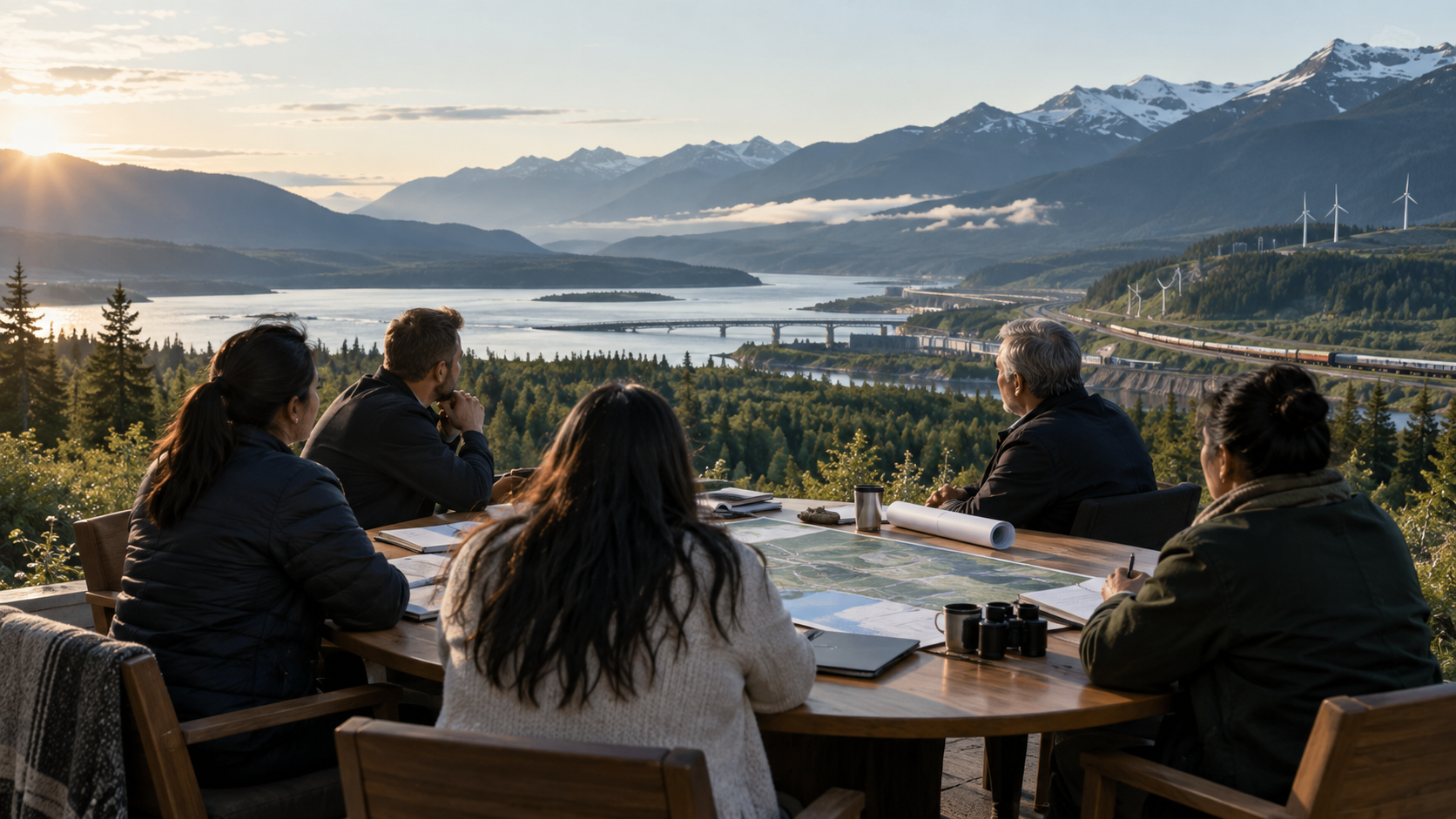
Image: Representative project-planning setting; not a specific Nation, summit or project location.
See what is changing. Understand what matters. Be ready to act.
Tuvvik helps organizations bring Indigenous participation, project strategy and capital into alignment before the most consequential decisions are fixed.
Start a Conversation